
How to Bond With Your Baby as a Dad: 8 Things That Work
Hi, I'm Angeline, mum of three and founder of SavvyMama. This one is for the dads, and for the mums who love them.
New dads are often told they'll feel a rush of love the moment they hold their baby. Maybe you did. Or maybe you held this tiny, red-faced stranger and mostly felt terror, exhaustion and a quiet thought you didn't say out loud: I'm not sure I feel what I'm supposed to feel yet.
If that's you, you're not broken, and you're definitely not alone. Bonding with your baby as a dad is often less of a lightning strike and more of a slow sunrise. It's built, not delivered. And the things that build it are almost all things you can start doing today.
Why doesn't bonding feel automatic for many dads?
Partly biology, partly logistics, and partly because nobody talks about it. Mum has had nine months of physical connection. She may be breastfeeding, and she often has the longer leave. In many Singapore homes, there's also a confinement nanny or grandparent stepping in. It's easy for a new dad to become the assistant: fetching things, washing bottles and handing the baby back the moment things get hard.
This is more common than you'd think. Research on the early postnatal period finds fathers face real stress, anxiety and low mood after birth. Paternal depression often looks like irritability, anger or withdrawal rather than obvious sadness, and it's linked to weaker father-infant bonding. Feeling disconnected makes you pull back, and pulling back makes you feel more disconnected.
The way out isn't to wait for the feeling. It's to do the things, because the feeling follows the doing.
What does the science say about father-infant bonding?
Here's the reassuring part: your body is set up for this. When first-time fathers held their newborns, their oxytocin, the same bonding hormone that underpins maternal bonding, rose compared with before the hold.
The key is what switches it on. Researcher Ruth Feldman's work on the parental brain suggests the caregiving systems in fathers activate less automatically. They switch on through ongoing, hands-on time with your baby. Mums get a hormonal head start. Dads get theirs by showing up, again and again. Those awkward first weeks aren't a sign you're bad at this. They're the on-ramp.
The 8 things that actually work
1. Skin-to-skin, and not just on day one
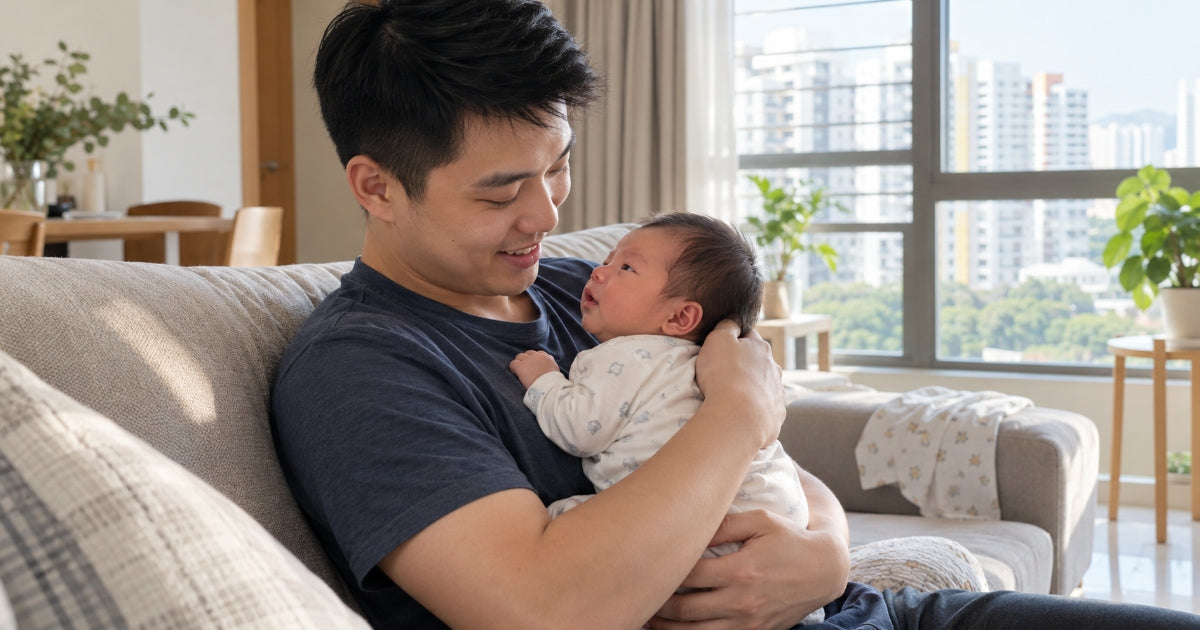
This is the most powerful thing on the list, and the one dads skip most because it feels like "the mum thing". It isn't. A randomised trial of father-newborn skin-to-skin found improved father-infant attachment and more caregiving behaviour, like talking to and touching the baby. Take your shirt off, put your baby on your chest and sit for fifteen minutes. It feels almost too simple, but it's doing more than you think.
2. Take a shift that's truly yours
Not "helping". Yours. The 5am wake-up, bath time, the evening walk around the void deck that gets them to sleep, or bottle feeds if that's an option. Being the one who solves the problem is how you learn to read your baby, and how your baby learns you're someone to rely on.
3. Play like a dad
Feldman's research found mother-baby interaction tends to flow gently, while father-baby interaction runs faster, with sudden peaks of excitement during play. The tickling, the swooping and the silly faces aren't second-best bonding. They're your own contribution.
4. Narrate everything
Talk to your baby before it feels reasonable. Describe the traffic, explain what you're cooking and give a running commentary on the walk to the playground. Babies soak up language and rhythm long before they speak. And it's very hard to feel like a spare part when you're mid-conversation, even a one-sided one.
5. Own one thing from start to finish
Pick something and become the expert: bath time, nappies, getting dressed or the Saturday morning outing. A lot of disconnection is really a confidence problem. Owning one thing breaks that cycle, and being the household expert on something is quietly bonding.
6. Carry them, a lot, and as they grow too
Carrying is the most underrated bonding tool for dads, and one of the few that keeps working past the newborn stage. Held babies cry less and settle faster. For you, carrying means hours of your child's warmth, breathing and reactions against your body, which is exactly the hands-on time that switches on the caregiving system.
Many dads stop carrying once their child gets heavy and wriggly, right when the conversation is getting good. That's a shame, and it's fixable.
7. Get outside together
Outdoors, there's more to look at, point at and talk about, and less pressure to be doing something useful. A walk at the Botanic Gardens or along a park connector is often where dads and kids are at their best. Just plan around the midday heat.
8. Give it time and stop scoring yourself
Bonding isn't a moment you either had or missed. It builds up. Many dads say the connection really lands around six months, when their baby starts laughing at them specifically. That's not late. That's normal.
If low mood, anger or numbness keeps going rather than lifting, please speak to your GP or polyclinic doctor. Paternal mental health is real and treatable. Feeling nothing is a symptom, not a verdict on you as a father.
Why does carrying help bonding so much?
Because it removes the choice. Every other bonding activity needs you to decide to do it. Carrying makes closeness the default. Your child is with you for the afternoon, and you get all the small moments that connection is really made of: the pointing, the questions and the falling asleep on you.
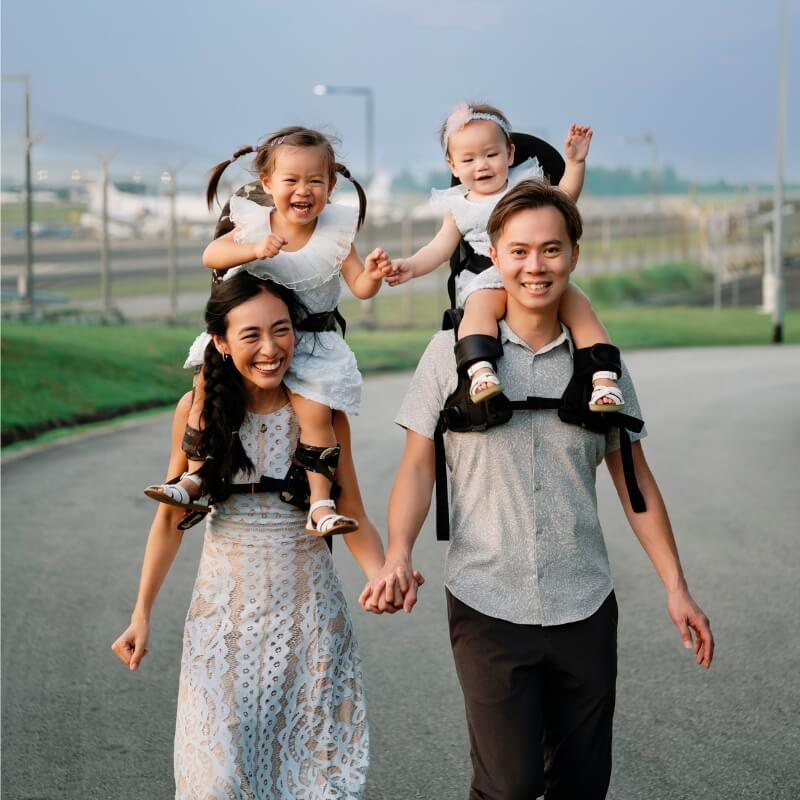
Once they're past six months, children often want to see the world rather than your chest, and shoulder height is the seat they ask for. The problem is that shoulders aren't built for it. Your neck aches, your hands are stuck holding their ankles, and you're done in ten minutes.
That's the problem the MiniMeis G5 shoulder carrier was built to solve, designed by Norwegian dads. The seat carries the load rather than your neck, and it's the only shoulder carrier certified to both EU (EN-13209-1) and US (ASTM F2549-14a) safety standards. TIME Magazine named it one of its Best Inventions.
In a MadeForMums review, a dad testing it with his 8-month-old admitted it felt a little unnatural at first, but his daughter loved it. That arc, from awkward to normal to their favourite thing, is also the arc of bonding itself.
[Angeline: add a note here if your husband or a dad in your community has used the G5.]
What should a dad look for in a baby carrier?
-
Light weight: You're carrying your child and the kit. The G5 weighs 1.6 kg.
-
Packability: A carrier that stays in the cupboard bonds nobody. The G5 folds flat to 30 x 30 cm, so it lives in the bag.
-
Safety you don't have to think about: A 7-point harness and dual certification mean your attention goes to your child.
-
Quick handovers: No readjustment is needed when you swap between parents.
-
Range: From 6 months to 4 years, up to 18 kg, covering the years most dads stop carrying.
One honest note: a shoulder carrier is best for short to medium outings, like the market, the playground or a family walk, rather than all-day hikes with a heavy four-year-old.
Ready to carry them a little longer? See the shoulder carrier in Singapore.
Frequently Asked Questions
How long does it take for a dad to bond with his baby?
There's no set timeline. Some dads feel it in the delivery room, while many say it clicks around three to six months. Regular hands-on time matters more than speed.
Is it normal for a dad not to feel an instant bond?
Yes, it's very common. Dads largely build these systems after birth, through contact. If numbness, irritability or withdrawal lasts beyond a few weeks, speak to your doctor.
Does skin-to-skin work for dads too?
Yes. Research on father-newborn skin-to-skin found improved attachment and more caregiving behaviour.
When can I put my baby on my shoulders in a carrier?
From around 6 months, and only once your baby can sit up unaided with steady head control. Before that, use a front carrier or sling.
What's the best baby carrier for dads?
The ones dads keep using are quick to put on, light, packable and something their child asks for. Shoulder carriers score well on all four.
REFERENCES:
-
PubMed. (2021). Fathers' oxytocin responses to first holding their newborns. Developmental Psychobiology. https://pubmed.ncbi.nlm.nih.gov/33860940/
-
PubMed Central. (2017). Effects of father-neonate skin-to-skin contact on attachment: A randomized controlled trial. https://www.ncbi.nlm.nih.gov/pmc/articles/PMC5282438/
-
PubMed Central. (2022). Prevalence of paternal stress, anxiety and depression in the early postnatal period. https://www.ncbi.nlm.nih.gov/pmc/articles/PMC9768414/
-
Feldman, R. (2022). The neural basis of human fatherhood. Ruth Feldman Lab. https://ruthfeldmanlab.com/wp-content/uploads/2023/05/2022.-The-Neural-Basis-of-Human-Fatherhood-A-Unique-Biocultural-Perspective-on-Plasticity-of-Brain-and-Behavior.pdf



Leave a comment
This site is protected by hCaptcha and the hCaptcha Privacy Policy and Terms of Service apply.