


What Happens to Your Child's Brain When You Carry Them
Hi, I'm Angeline, mum of three and founder of SavvyMama. Every parent knows this moment. You swing your toddler up, their legs settle around your shoulders, and something changes. The whining stops, their little body relaxes, and a small voice starts narrating everything it can suddenly see.
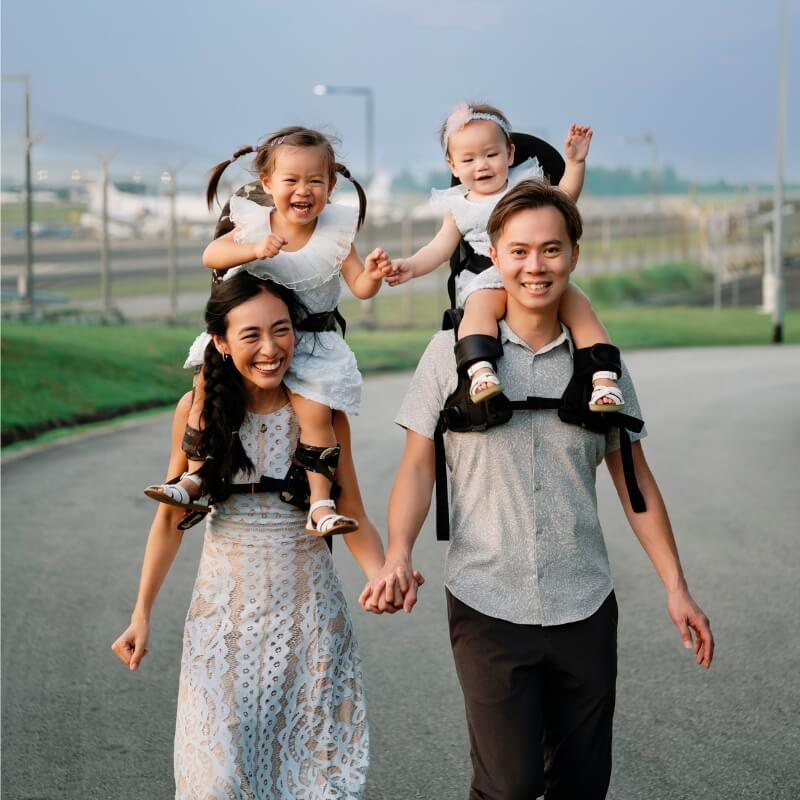
It feels like magic, but it's actually neuroscience. When you carry your child, whether on your shoulders, your hip or in a carrier, you're giving their developing brain a rich stream of sensory, emotional and social input. The carrying toddler on shoulders benefits go well beyond getting from A to B: carried children cry less, connect more and get a daily workout for balance, movement, language and emotional security.
Here's what's happening up there.
Why does movement matter so much to a growing brain?
Deep in your child's inner ear sits the vestibular system, a set of fluid-filled canals that sense every tilt, turn and bounce of the head. It's one of the earliest senses to develop, and it's the foundation for balance, coordination and spatial awareness.
The vestibular system doesn't develop by sitting still. It develops through movement: rocking, swaying, changes of direction and height. Researchers reviewing vestibular activity in children note that head movements through space give the brain the signals it uses to map where the body is and how to keep it upright. Some researchers even call it "the neglected sense".
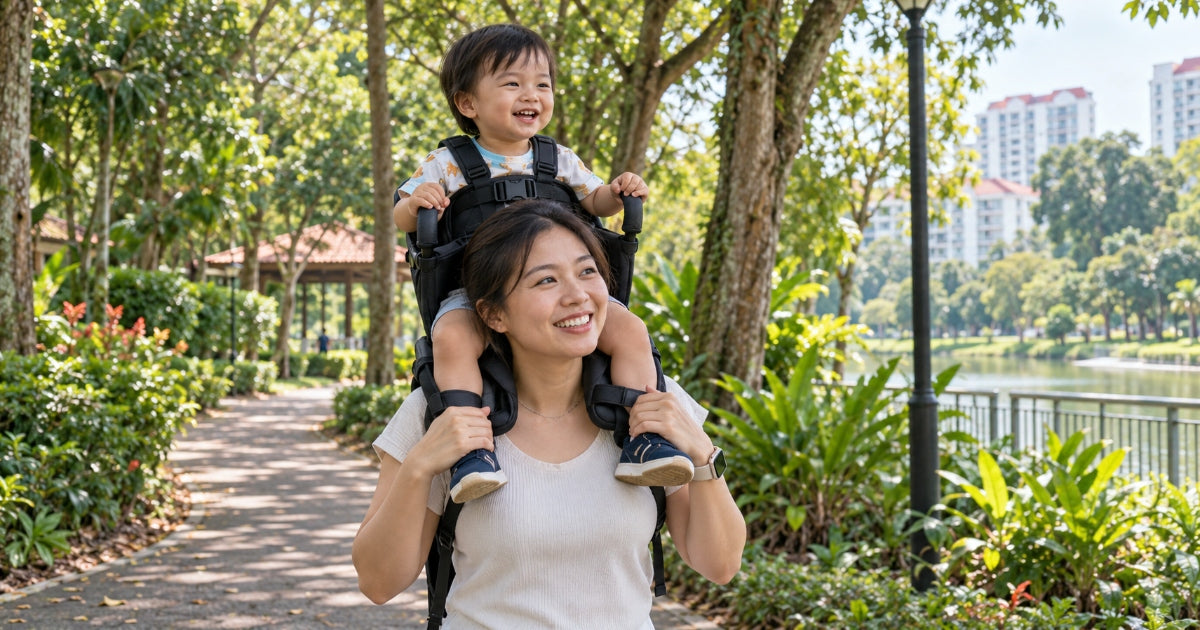
When your toddler rides on your shoulders, their vestibular system is busy the whole time. Every step, turn and slope sends gentle motion data to their brain, and they make hundreds of tiny adjustments to stay balanced without realising it. Occupational therapists use swings and balance boards for exactly this kind of input. A walk on your shoulders gives it for free.
Is carrying actually a workout for my toddler?
It looks passive, but it isn't. A child at shoulder height is quietly engaging their core, adjusting their posture as you move and using neck and trunk muscles to hold their head steady. Paediatric therapists see core and shoulder stability as the base for later skills like drawing, cutting and writing.
Carrying also gives proprioceptive input, the sense of where your body is and what it's touching. That deep, steady contact has a calming effect, which is one reason a cranky toddler often settles within a minute of being picked up.
So no, carrying your toddler won't make them lazy or delay walking. A worry I hear often, usually from well-meaning relatives! The child on your shoulders is balancing and sensing the whole time. Then you put them down, and they run.
What does carrying do to a child's stress levels?
This is where the research gets remarkable. In a 1986 randomised controlled trial by Hunziker and Barr, published in Pediatrics, 99 mother-infant pairs were split into a "supplemental carrying" group and a control group. At six weeks, when crying normally peaks, the carried babies cried and fussed 43% less overall and 51% less in the evening.
Hormones explain why. Close physical contact releases oxytocin, the bonding hormone, and lowers cortisol, the stress hormone. A systematic review found parental oxytocin is linked to touch, gaze and the back-and-forth rhythm between parent and child, and it rises in mums, dads and children during close contact.
Every carry is a small deposit into your child's stress-regulation system. A child who knows comfort is reliably there becomes more independent, not less, because they trust the safe base they're exploring from.
Does carrying really help language development?
Think about what your toddler sees from a stroller: knees, shopping bags and the underside of the world. Now think about what they see from your shoulders. The cat at the void deck, the bus pulling in, the hawker uncle at his stall. They see it all with you, at your eye level, hearing your commentary right beside their ears.
Developmental psychologists call this joint attention: parent and child focusing on the same thing at the same time. It's one of the strongest drivers of early language. Research has found that a child's ability to respond to joint attention at 12 months predicts their language at 24 months.
A shoulder carrier is, in effect, a joint-attention machine. They point, you name. "Bus!" "Yes, a big red bus. It's stopping to pick people up." Twenty minutes of that on a walk is a language lesson no app can match.
Why do children remember being carried?
Ask adults about their happiest early memories and shoulder rides come up again and again. Moments with novelty, a little thrill, closeness and a parent's full attention are exactly the kind the brain holds on to.
From up high, the world feels bigger and safer at the same time. Your child gets the thrill of height with the security of holding on to you. That mix of excitement and safety is where children stretch their comfort zone, and it's why kids ask for "shoulders!" the way they ask for their favourite bedtime story.
Does it matter how you carry them?
By the toddler years, the question isn't whether carrying is good for your child. It's whether your body can keep it up. A 12 kg three-year-old balanced freehand on your shoulders means a strained neck, clenched hands gripping two small ankles and a child gripping your hair. Most parents stop carrying long before their child stops wanting to be carried.
This is the problem the MiniMeis G5 shoulder carrier was designed to solve. Created by Norwegian dads and named one of TIME Magazine's Best Inventions, it's a structured seat that spreads your child's weight through your torso instead of your neck, with a 7-point harness keeping them secure. It's the only shoulder carrier certified to both EU (EN-13209-1) and US (ASTM F2549-14a) safety standards.
It weighs 1.6 kg, folds flat to 30 x 30 cm and works from 6 months to 4 years, up to 18 kg. So the balance practice, shared attention and happy memories can keep going long after your arms would have given up.
[Angeline: add a short personal note here if your family has used the G5.]
The takeaway: carrying is brain food
Children are built to be carried, and good things happen when they are: a calmer nervous system, better balance, richer language, deeper attachment and memories that last.
So the next time your toddler raises their arms and says "up", they're not being demanding. They're asking for exactly what their brain needs.
Give them the view and save your back. Explore the toddler shoulder carrier in Singapore.
Frequently Asked Questions
Is carrying a toddler on your shoulders good for them?
Yes, when done safely. It stimulates balance, engages core muscles and puts your child at your eye level for shared attention and conversation. For longer periods, use a certified carrier so your child is secure and your neck and back are protected.
At what age can a child ride on your shoulders?
Freehand shoulder rides should wait until your child has strong head and trunk control and can hold on reliably. A structured carrier like the MiniMeis G5 can be used from 6 months, once your baby sits unsupported, up to 4 years or 18 kg.
Does carrying my toddler delay walking or make them clingy?
No. Carrying supports motor development, and children whose need for closeness is met become more confident explorers.
Is a shoulder carrier comfortable in Singapore's heat?
It can be cooler than a front carrier because there's less body-to-body contact. Go out in the cooler morning or evening, use shade and bring water for both of you.
Is a shoulder carrier better than a backpack carrier?
Both are safe when certified. On a shoulder carrier, your child shares your exact line of sight, which supports joint attention. It's also lighter than most framed backpacks and folds flat for travel.
REFERENCES:
-
Hunziker, U. A., & Barr, R. G. (1986). Increased carrying reduces infant crying: A randomized controlled trial. Pediatrics, via PubMed. https://pubmed.ncbi.nlm.nih.gov/3517799/
-
PubMed Central. (2013). Vestibular activity and cognitive development in children. https://www.ncbi.nlm.nih.gov/pmc/articles/PMC3858645/
-
PubMed. (2023). Oxytocin and parent-child interaction: A systematic review. https://pubmed.ncbi.nlm.nih.gov/36811366/
-
Infancy. (2022). Joint attention as a developmental catalyst. Wiley Online Library. https://onlinelibrary.wiley.com/doi/10.1111/infa.12515

Leave a comment
This site is protected by hCaptcha and the hCaptcha Privacy Policy and Terms of Service apply.