
Article: The Benefits of Babywearing: Why Carrying Your Child Changes Everything
The Benefits of Babywearing: Why Carrying Your Child Changes Everything
Hi, I'm Angeline, mum of three and founder of SavvyMama. If you've ever scooped up a fussing baby, held them close and started walking, you'll know the moment the crying melts away. It feels like instinct. It turns out it's also biology.
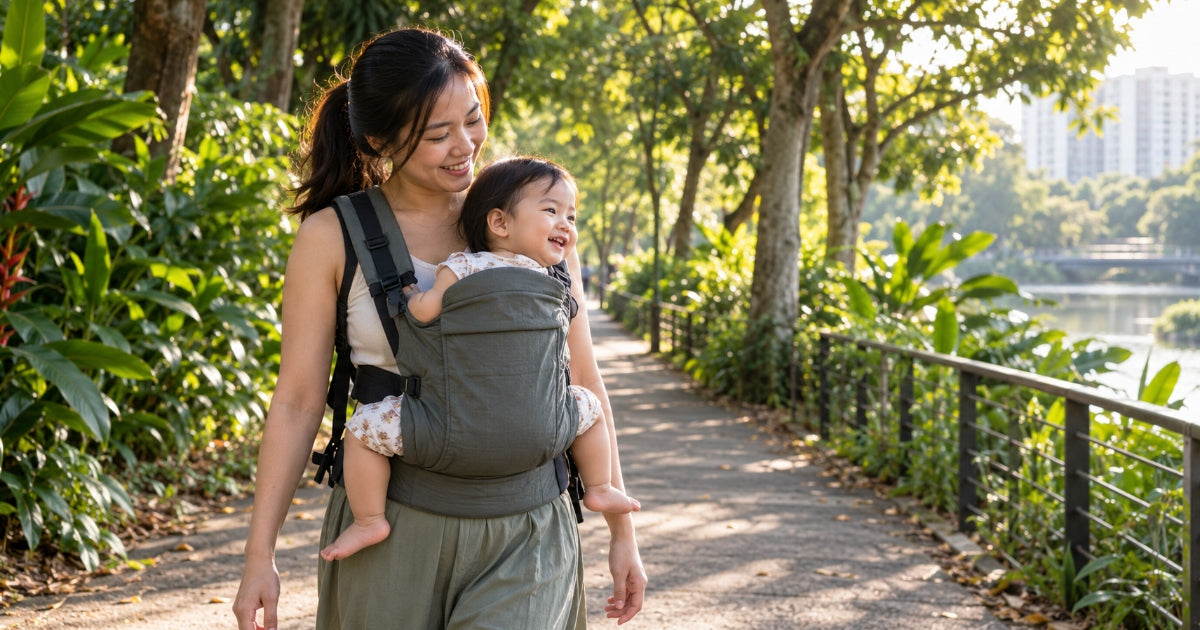
Parents have carried their babies for as long as there have been babies. Long before prams, cots and bouncers, there were arms, hips and slings. So when people call babywearing a trend, I smile, because it's one of the oldest parenting practices there is. Here in Singapore, plenty of us grew up being carried by grandparents in a cloth sling.
The benefits of babywearing go far deeper than convenience. Carrying changes your child's stress levels, brain development and sense of security, and it changes your hormones too. Here's what the research says, and why it matters whether your child is six weeks or four years old.
Does babywearing really reduce crying?
This benefit has the most famous study behind it. In 1986, researchers Hunziker and Barr ran a randomised controlled trial with 99 mother-infant pairs, published in the journal Pediatrics. One group carried their babies more through the day, and the other carried on as usual. At six weeks, when infant crying usually peaks, the carried babies cried and fussed 43% less overall and 51% less in the evening, that exhausting "witching hour" so many of us know too well.
The effect held at eight weeks and was still measurable at twelve. Later studies haven't always matched those exact numbers, and most of the carrying in that trial was in-arms. But the bigger picture is clear: physical closeness calms babies. A calmer baby usually means a calmer parent.
Why does carrying release oxytocin?
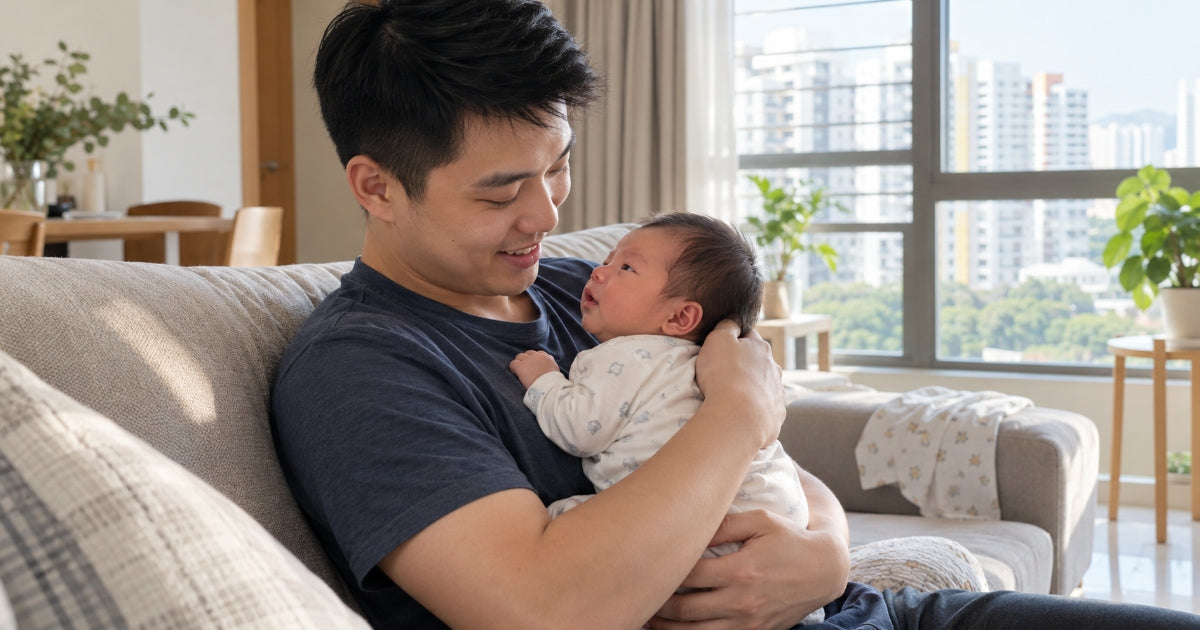
When you hold your child against your body, your brain releases oxytocin, often called the "bonding hormone". It's the same hormone that rises during breastfeeding and cuddles.
It works both ways. A systematic review of oxytocin and parent-child interaction found parental oxytocin is linked to touch, gaze and the back-and-forth rhythm between parent and baby. As oxytocin rises, cortisol, the main stress hormone, tends to fall. Parents who carry often find it easier to read their baby's cues and respond quickly. You're not just calming your baby in the moment. You're tuning your own responsiveness, one carry at a time.
How does babywearing support secure attachment?
Attachment theory, pioneered by John Bowlby and Mary Ainsworth, says that a child who gets consistent, responsive care builds a "secure attachment": an inner sense that the world is safe and their needs will be met.
Babywearing feeds straight into this. When your baby is close, you notice every wriggle, noise and reach, and you answer faster.
I know the worry, often passed down lovingly by grandparents, that carrying "too much" will make a child clingy. The research points the other way. A child who knows their safe base is always there is the child most willing to wander off and explore.
What does carrying do to your child's brain?
This is the part that fascinates me, and it's why babywearing matters for toddlers, not just newborns.
The first effect is vestibular stimulation. The vestibular system in the inner ear controls balance and spatial awareness. Researchers reviewing vestibular activity and child development note that movement through space gives the brain the signals it needs to build balance and coordination. Every step, turn and slope you take while carrying gently exercises it.
The second is language and social exposure. A carried child isn't staring at the underside of a pram canopy. They're up at adult height, watching faces and hearing conversations. Whether you're at the hawker centre, the playground or the MRT platform, they're folded into the day rather than parked beside it.
When carrying gets harder: the toddler problem
Here's the catch. Most of these benefits are easiest to reach in the newborn months, when a soft wrap holds a small baby against your chest. But the science doesn't stop at twelve months, and neither does your child's wish to be close to you.
Past their first birthday, toddlers get heavier, longer and much more interested in seeing the world than in being tucked against your collarbone. They squirm, lean back and fight the front carrier. Add Singapore's heat, and a padded chest carrier can feel like a portable sauna.
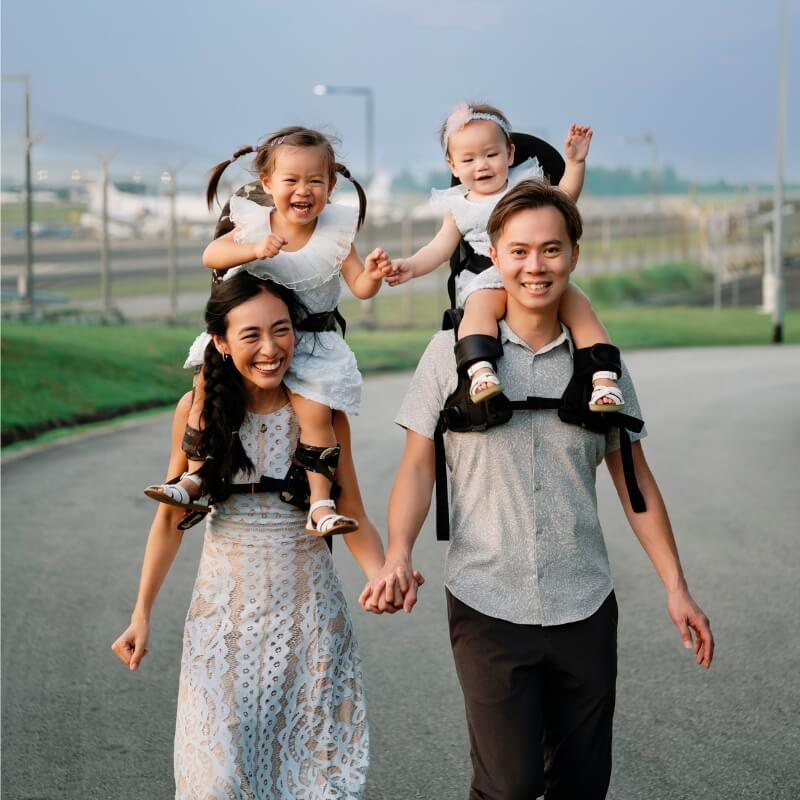
This is the gap a shoulder carrier closes. By seating your child on your shoulders instead of against your front, you keep the closeness, conversation and shared view, while your toddler gets the panoramic view they're desperate for. Think of it as babywearing, grown up.
What we can learn from Norway's open-air families
Norwegians have a word, friluftsliv, roughly "open-air life". Families head outside year-round, and Norwegian kindergartens build outdoor play into every day. It's also why Norwegian gear for children tends to be built to last: products have to work in real weather, with real toddlers. That's the culture the MiniMeis came from, designed by Norwegian dads who wanted to keep carrying their children outdoors.
Where the MiniMeis G5 fits in
The MiniMeis G5 shoulder carrier seats your child securely on your shoulders, so your toddler gets the best view and you keep both hands free. It's suitable from 6 months, once your child can sit up unaided, up to 4 years or 18 kg. That covers exactly the window when front carriers start to give up.
A few things stand out to me:
-
It's the only shoulder carrier certified to both EU (EN-13209-1) and US (ASTM F2549-14a) safety standards, which matters when you're lifting your child to head height.
-
A 7-point harness keeps your child secure, with no readjustment needed when you swap between parents.
-
It weighs 1.6 kg and folds flat to 30 x 30 cm, about the size of a laptop, so it slips into a day bag for Grab rides and MRT trips.
-
It was named one of TIME Magazine's Best Inventions and is made with recycled ocean-plastic fabric.
[Angeline: add a short personal note here if you or your family have used the G5.]
The bigger picture
Carrying your child is one of the simplest, most powerful things you can do for them. It calms them, supports their brain, builds their security and floods you both with the hormones of connection.
Your arms were the first baby carrier your child ever needed. A good carrier just helps you keep offering that closeness as they grow heavier, taller and hungrier for the view. Carry them while you can, because the years really are short.
Keep your little one close as they grow. Explore the MiniMeis shoulder carrier in Singapore.
Frequently Asked Questions
At what age should you start babywearing?
Many parents start from birth with a newborn-appropriate carrier that supports the head and neck. A shoulder carrier like the MiniMeis G5 works from 6 months, once your child can sit unaided, up to 4 years or 18 kg.
Does babywearing spoil a baby or make them clingy?
No. Carrying supports secure attachment, and securely attached children tend to be more confident explorers, not less.
Is babywearing comfortable in Singapore's heat?
It can be. Choose breathable fabrics, dress your child lightly, take shade breaks and keep them hydrated. For toddlers, a shoulder carrier avoids the body-to-body heat of a padded front carrier.
Is babywearing good for the parent too?
Yes. The same oxytocin that bonds you to your child also lowers your own stress, and a calmer baby is easier on a tired parent.
What's the best baby carrier in Singapore for a toddler?
For the 6-month-to-4-year window, a shoulder carrier is hard to beat. The MiniMeis G5 is certified to EU and US safety standards, weighs 1.6 kg and folds flat for travel.
REFERENCES:
-
Hunziker, U. A., & Barr, R. G. (1986). Increased carrying reduces infant crying: A randomized controlled trial. Pediatrics, via PubMed. https://pubmed.ncbi.nlm.nih.gov/3517799/
-
PubMed. (2023). Oxytocin and parent-child interaction: A systematic review. https://pubmed.ncbi.nlm.nih.gov/36811366/
-
PubMed Central. (2013). Vestibular activity and cognitive development in children. https://www.ncbi.nlm.nih.gov/pmc/articles/PMC3858645/

Leave a comment
This site is protected by hCaptcha and the hCaptcha Privacy Policy and Terms of Service apply.