
Article: Baby Carrier Safety: The T.I.C.K.S. Rule Every Singapore Parent Should Know

Baby Carrier Safety: The T.I.C.K.S. Rule Every Singapore Parent Should Know
Babywearing makes life with a little one easier, whether you are soothing a newborn at home or making your way through a crowded hawker centre with both hands free. But comfort and convenience depend on getting baby carrier safety right every single time you strap in. A carrier that is too loose, a baby positioned too low, or a chin tucked onto the chest can affect breathing, while a poor fit can leave parents with aching shoulders and backs. This guide explains the T.I.C.K.S. rule, how to wear a baby carrier correctly at each stage, and what to look for when choosing an ergonomic baby carrier in SG.
What Is the T.I.C.K.S. Rule?
T.I.C.K.S. is a simple checklist created by the UK Sling Consortium and shared by NHS services, including NHS Grampian, to help parents carry babies safely in slings and soft carriers. Each letter stands for one quick check you can run through before every carry.
T: Tight
The carrier should hug your baby close to your body. According to sling safety guidance from the National Child Mortality Database, any slack or loose fabric allows a baby to slump down, which can hinder their breathing and pull on your back.
I: In View at All Times
You should be able to see your baby's face simply by glancing down. The fabric should never close over them so that you need to open the carrier to check on them.
C: Close Enough to Kiss
Your baby's head should sit as close to your chin as is comfortable, so that tipping your head forward lets you kiss the top of their head or forehead.
K: Keep Chin Off the Chest
A baby should never be curled so that their chin is forced onto their chest, as this can restrict breathing. NHS Grampian's T.I.C.K.S. guidance recommends always leaving at least a finger's width of space under your baby's chin.
S: Supported Back
In an upright carry, your baby's back should be supported in its natural position, with their tummy and chest against you. A quick test is to place a hand on your baby's back and press gently; they should not uncurl or move closer to you.
How to Wear a Baby Carrier at Each Stage
Newborns (0–3 Months)
Carry newborns upright, facing in and high on your chest. Use any newborn insert or adjustment your carrier requires, and make sure the fabric supports the head and neck without covering the face. If you are still recovering from birth, keep sessions short at first and build up gradually; our guide to preparing for confinement Confinement in Singapore: What to Prepare for the First 30 Days covers what to have ready for those early weeks.
Babies (4 Months and Up)
As head and neck control improve, babies can enjoy longer carries. Some carriers allow outward-facing positions once a baby has strong head control, but follow the manufacturer's minimum age and keep these carries short, because babies cannot turn inward to rest when they feel overstimulated.
Toddlers
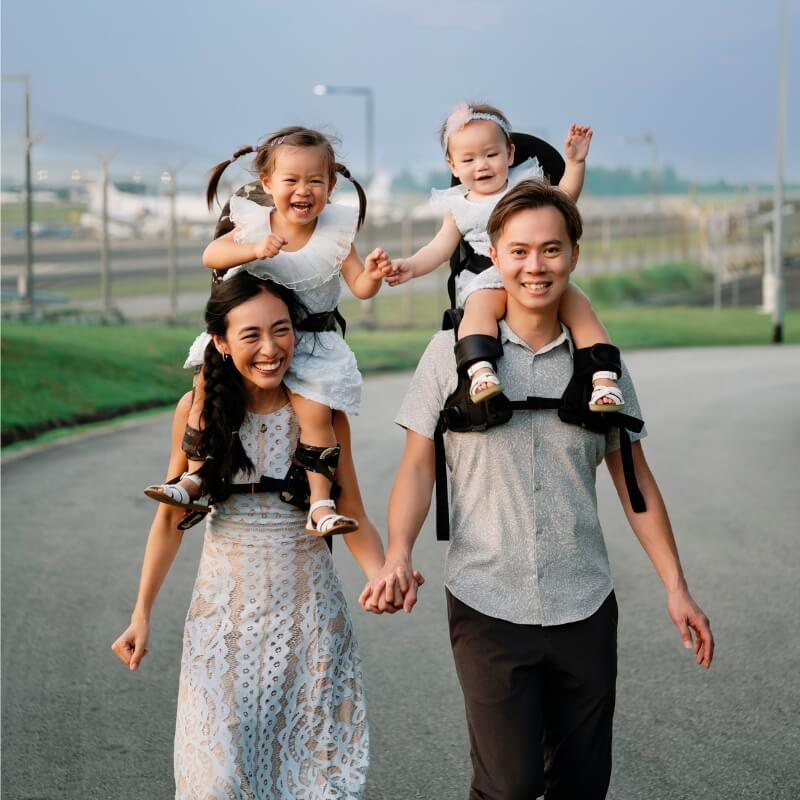
Older babies and toddlers are often more comfortable on the hip or back, where their weight sits closer to your centre of gravity. For short outings with a curious toddler who wants to see everything, a MiniMeis shoulder carrier is another option many families enjoy alongside their everyday carrier.
Why Hip Positioning Matters
The way your baby's legs sit in a carrier affects their developing hips. The recommended position is often called the M-position: knees raised slightly higher than the bottom, thighs supported from knee to knee, and hips spread naturally. A 2023 study reported by Boise State University used ultrasound imaging to compare carriers and found that wide-base carriers held infant hips in a position similar to the Pavlik harness used to treat hip dysplasia, while narrow-base carriers showed concerning results. When choosing a carrier, look for a wide seat that supports the thighs rather than letting the legs dangle straight down.

AI Generation Prompt: Photorealistic close-up photo of an Asian baby in an ergonomic carrier showing the hip-healthy M-position: knees slightly higher than the bottom, thighs supported from knee to knee by a wide fabric seat. The parent wears a light cotton T-shirt; soft natural indoor light in a modern Singapore home. No text, no logos, no brand names. 4:3 aspect ratio.
Preventing Overheating in Singapore's Climate
Babywearing in tropical heat needs extra care, because body heat, padding and humidity add up quickly. Dress your baby in one less layer than usual, since the carrier itself counts as a layer. Choose breathable mesh panels where possible, keep your baby's face uncovered and check the back of their neck often; if it feels hot or damp, take a break somewhere cooler. Plan longer walks for mornings and evenings, and keep both of you well hydrated.
Sweat trapped between baby and parent can also cause prickly heat on the chest and neck. Our guide to prickly heat and baby rashes Prickly Heat and Baby Rashes in Singapore: Causes, Prevention and Care explains how to recognise it early and keep skin comfortable.
Choosing an Ergonomic Baby Carrier
A well-designed carrier makes safe positioning much easier. Look for:
-
Wide, padded shoulder straps and a supportive waist belt.
-
An adjustable seat that supports the M-position as your baby grows.
-
Breathable fabric suited to Singapore's weather.
-
Clear minimum and maximum weight limits.
-
Simple buckles you can fasten confidently on your own.
Try a carrier on with your baby before committing, as fit varies between body types. Browse our ergonomic baby carrier range to compare designs, or visit the SavvyMamaSG store for hands-on help with fit. A carrier you find comfortable is one you will actually use safely.
Common Fit Mistakes to Avoid
-
Wearing the carrier too low, so your baby's head sits well below your chin.
-
Leaving straps loose because it feels cooler or more comfortable.
-
Fastening the waist belt low on the hips instead of at your natural waist.
-
Letting your baby's legs hang straight down without thigh support.
-
Bending forward at the waist instead of squatting, which can tip your baby forward.
A quick check in front of a mirror before you head out helps you spot these mistakes early, and it becomes second nature after a few weeks of practice.
When to Replace a Carrier
Check your carrier regularly for fraying straps, cracked buckles, loose stitching or thinning fabric, and replace it if you spot any of these. Take care with second-hand carriers too: confirm the model has not been recalled and that all parts and instructions are included.
Frequently Asked Questions
What does T.I.C.K.S. stand for?
Tight, In view at all times, Close enough to kiss, Keep chin off the chest, and Supported back. These are five quick checks for safe babywearing.
When can my baby face outwards in a carrier?
Only once they have strong head and neck control and your carrier allows it. Follow the manufacturer’s minimum age and keep outward-facing carries short.
Can my baby sleep in a carrier?
Babies often doze in carriers, which is fine as long as you keep following T.I.C.K.S. For longer sleeps, transfer your baby to a safe, flat sleep space.
How do I know if my baby is too hot in the carrier?
Feel the back of their neck. If it is hot or sweaty, or their face looks flushed, remove a layer and move somewhere cooler.
Is babywearing safe after a caesarean?
Many mums can carry their babies gently after a caesarean, but recovery varies. Check with your doctor, avoid pressure on the wound and start with short sessions.
Final Thoughts
A carrier that is fitted correctly keeps your baby safe and makes everyday life easier. Run through T.I.C.K.S. every time, check the hip position, and adjust for the heat. Explore SavvyMamaSG for babywearing and parenting essentials chosen for Singapore families.
Find a carrier that fits you both. Shop ergonomic baby carriers at SavvyMamaSG.
REFERENCES:
-
NHS Grampian. (2020). The T.I.C.K.S. Rule for Safe Babywearing. Birth Grampian. https://www.birthingrampian.scot.nhs.uk/wp-content/uploads/2020/08/ticks.pdf
-
National Child Mortality Database. (n.d.). Sling safety. NCMD. https://www.ncmd.info/safety/sling-safety/
-
Boise State University. (2023). New research study suggests benefits to wide-base baby carriers. Boise State News. https://www.boisestate.edu/news/2023/06/28/new-research-study-suggests-benefits-to-wide-base-baby-carriers/


Leave a comment
This site is protected by hCaptcha and the hCaptcha Privacy Policy and Terms of Service apply.